For CEOs
AI readiness for CEOs: what can’t be delegated
Most companies hand AI to IT, a data office or a program team, and then wonder why it stalls. The book’s answer is that what blocks AI is rarely the technology: it is unsettled questions about who owns what and what core business terms mean, and only the top of the company can make the organization settle them. Its ninety-day reset shows how a CEO sends that signal quickly.
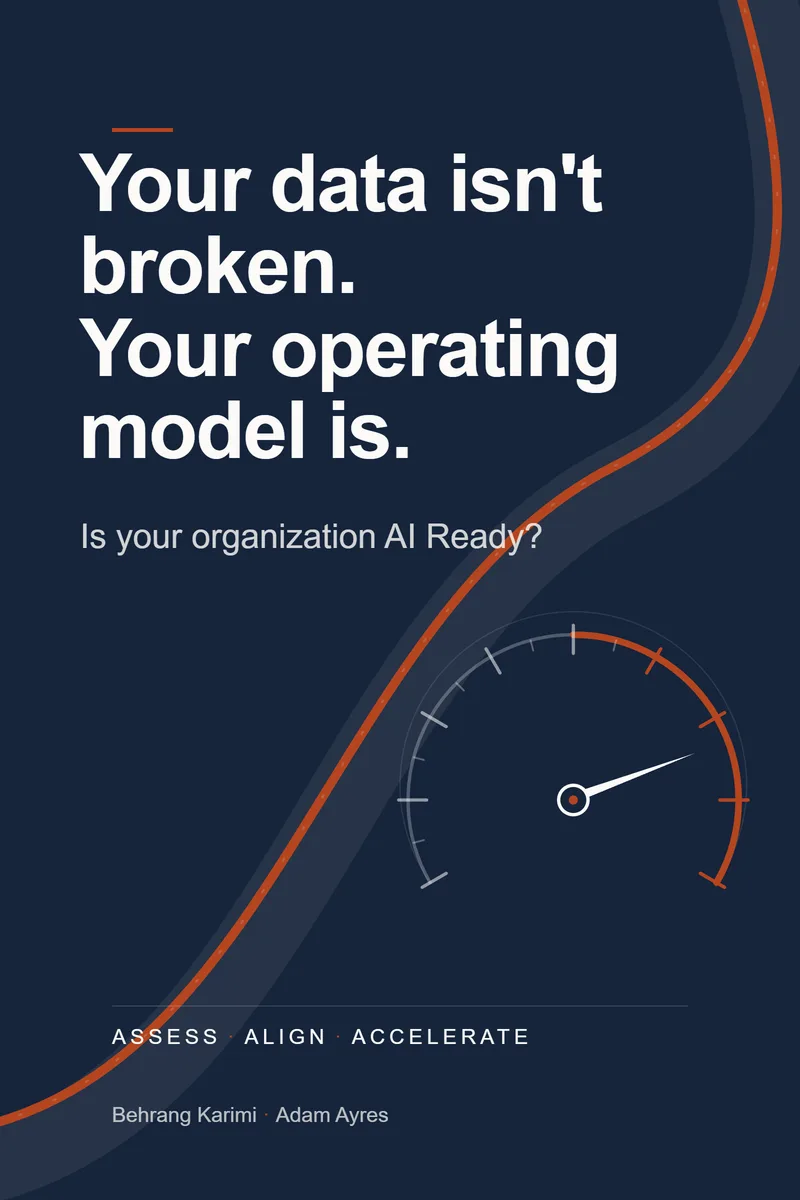
Kindle edition · 99 pages · a 90-minute readRead a free sample on Amazon
From the book
What the book shows
- 01
Handing it off is the classic mistake
The book is blunt about where AI readiness goes wrong first: leaders treat it as a technical program and pass it down. The first ninety days, it argues, are about signal rather than delivery — what the leadership team chooses to clarify, enforce and stop tolerating.
“Too often, executives treat this as something to delegate—to a Chief Data Officer, to IT, to a program office, to a platform initiative. That almost guarantees slow impact.”
Chapter 16The CEO’s Ninety-Day Reset - 02
Your exceptions become the policy
The reset is a short list of moves: reset the narrative, drop the idea that every system must be replaced first, make ownership non-negotiable, demand a one-page view of how the business operates, freeze the core definitions, simplify governance, and stop the habits that cause the problem. Each works because the organization copies what the top tolerates.
“Every exception tolerated at the top becomes policy everywhere else.”
Chapter 16The CEO’s Ninety-Day Reset - 03
It resets conditions, not results
The book is honest about what ninety days buys: ownership becomes visible, language starts to align, debates resolve faster. In its first (anonymized) case study, the CEO instituted a technical freeze and forced a structural pivot — after which inventory models that had stalled for years finally scaled.
“After ninety days, nothing magical has happened. But something fundamental has changed.”
Chapter 16The CEO’s Ninety-Day Reset
The part only the CEO can play
The book splits the jobs clearly: business leaders decide structure, meaning and ownership; technology leaders make those decisions work; transformation teams coordinate. The CEO’s part is narrower — and impossible to hand to anyone else.
“The CEO defines the expectation that the enterprise must be understandable to itself—and protects that expectation when it becomes inconvenient.”
Questions to ask
Questions to put to yourself and your executive team, drawn from the reset:
- 1Can we explain how the company operates on one page — not the org chart, not the system map?
- 2For each critical data domain, which named person — not a committee, not a function — owns what it means?
- 3Have we said out loud that becoming AI-ready does not depend on replacing every system?
- 4Which core definitions should we freeze for a while, so they stop being renegotiated every quarter?
- 5How many of our forums can say what they actually decide?
- 6Do our meetings ask “which system is right?” — or “who owns this, and is it fit for the decision?”
- 7Which exceptions have we tolerated at the top that are now policy everywhere else?
Where to start in the book
Chapter 16
The CEO’s Ninety-Day Reset — the seven moves of the ninety-day reset.
Chapter 14
Aligning the Leadership Team — why looking at the same dashboard is not alignment.
Chapter 18
Leading the Acceleration — who leads what: the CEO, business leaders, technology and transformation.
Kindle edition · 99 pages · a 90-minute readRead a free sample on Amazon
Also see
- Boards & audit committeesAI readiness questions every board should ask
- CFOsAI readiness for CFOs: questions to ask before funding more AI
- Transformation leadersWhy transformations fail before they start
All roles: who the book is for →
About this page: our reading of Your data isn’t broken. Your operating model is. by Adam Ayres and Behrang Karimi, for CEOs. The book itself is written for the leadership teams of complex enterprises. Quotes are word for word from the book; its case studies describe anonymized companies, and their results are not benchmarks.