For Chief Data Officers and data and analytics leaders
Data readiness for AI isn’t enough
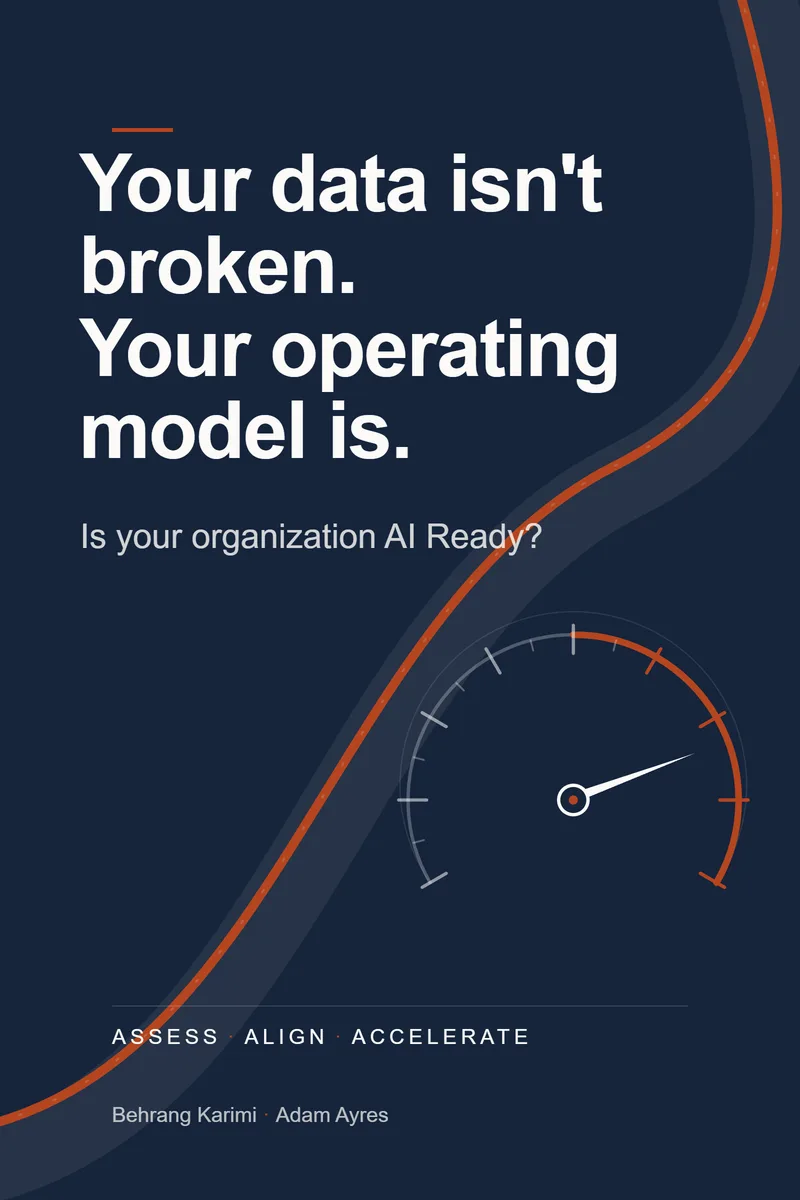
Most data-readiness work for AI focuses on the data itself: quality, catalogs, platforms. The book argues that this treats a symptom, because data quality is produced by how the business operates and by who owns what the data means. For data leaders, the book is an argument for getting the business — and the CEO — to own meaning with you, rather than carrying it alone.
Kindle edition · 99 pages · a 90-minute readRead a free sample on Amazon
From the book
What the book shows
- 01
Quality is made upstream
Cleanup projects improve the metrics for a while, then the gains fade once the project ends, the book says, because they treat systemic process flaws as random technical errors. Lasting quality comes from the operating teams that create the data understanding what it is used for.
“Data quality is an operational outcome, and accountability for it belongs to the people who generate the footprint—not to the team that stores it.”
Chapter 5The Diagnostic Mirror: Why Your Data Exposes Your Business - 02
An owner is a person, not a committee
The book defines ownership through four questions: what the data represents, how it is meant to be used, what quality a decision needs, and who is accountable when things go wrong. Councils and forums help coordination, it says, but cannot carry accountability.
“Data without a clear owner is not an asset; it is an opinion backed by infrastructure.”
Chapter 11Ownership Is a Leadership Role - 03
Data in a vault creates no value
The book warns against treating data as an asset to be stored and protected. Its value appears only when it drives decisions — which is why the book wants the CEO, not the data office alone, to make ownership non-negotiable.
“When data is treated as a static asset, catalogs grow faster than usage, governance devolves into compliance, and business engagement disappears.”
Chapter 5The Diagnostic Mirror: Why Your Data Exposes Your Business
What to share — and what to leave alone
The book’s alternative to ever-larger data platforms is a short list of things the whole enterprise must share: a common language, common definitions, named ownership, a shared operating structure, and shared rules for what may differ locally. Everything else — tooling, local processes, ways of working — can vary. Its Operating Tree gives every number a business context to sit in.
Questions to ask
Questions for data and analytics leaders:
- 1For each critical domain, is the owner a named business leader with decision authority — or a committee, or us?
- 2When a quality issue recurs, do we trace it to the process and the workflow owner that produced it?
- 3Which core terms — customer, order, revenue — still mean different things in different systems?
- 4Is our catalog growing faster than its use in actual decisions?
- 5Are we building a data layer to referee between competing definitions instead of settling them?
- 6Does the CEO, not just the data office, treat ownership as non-negotiable?
Where to start in the book
Chapter 5
The Diagnostic Mirror: Why Your Data Exposes Your Business — the Diagnostic Mirror: why your data exposes your business.
Chapter 9
Standardize What Must Be Shared (and Nothing More) — the few things worth standardizing — and the many that are not.
Chapter 11
Ownership Is a Leadership Role — ownership as a leadership role.
Kindle edition · 99 pages · a 90-minute readRead a free sample on Amazon
Also see
- CIOs & CTOsWhy IT can’t fix what the business hasn’t decided
- Heads of AIWhy AI pilots fail to scale: six conditions
- COOsBad data is an operations problem: AI readiness for COOs
All roles: who the book is for →
About this page: our reading of Your data isn’t broken. Your operating model is. by Adam Ayres and Behrang Karimi, for Chief Data Officers and data and analytics leaders. The book itself is written for the leadership teams of complex enterprises. Quotes are word for word from the book; its case studies describe anonymized companies, and their results are not benchmarks.