For transformation and change leaders
Why transformations fail before they start
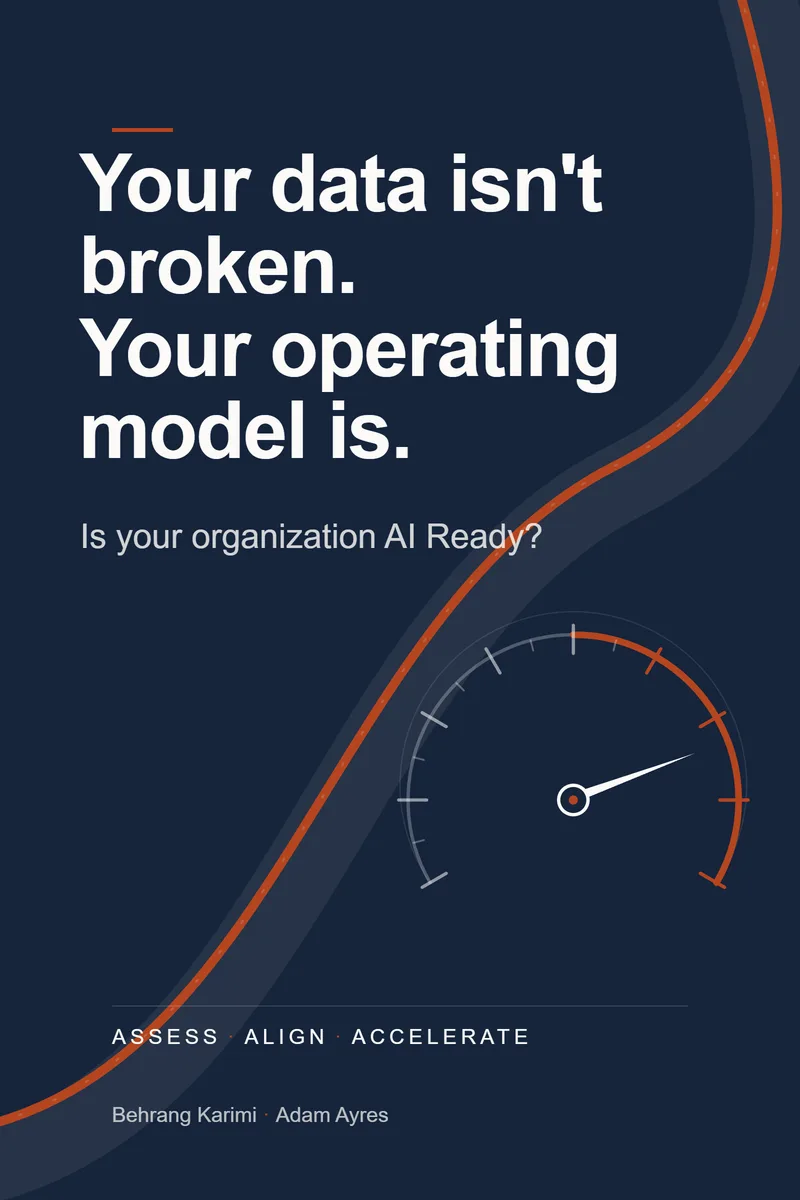
Many transformations look healthy for months: budgets approved, roadmaps drawn, platforms chosen, consultants in place. The book argues that most fail at the design stage, because they start downstream with technology, reporting or integration while the real problems — unclear ownership, conflicting definitions, unresolved trade-offs — sit upstream with leadership. For transformation leaders, it is a case for fixing the sequence before the plan.
Kindle edition · 99 pages · a 90-minute readRead a free sample on Amazon
From the book
What the book shows
- 01
Motion is not progress
New vocabulary arrives — single source of truth, modern data platform, AI readiness — followed by target architectures, multi-year roadmaps and migration waves. Activity rises, and the question that matters stays open: what actually has to change in the way the business runs?
“Transformations are particularly effective at creating an illusion of progress.”
Chapter 6Why Transformations Often Fail Before They Start - 02
Technical teams end up as referees
When alignment is attempted only after processes, ownership and structures have drifted apart, technical teams are pushed into mediating between competing versions of reality instead of enabling decisions.
“That is not transformation. It is arbitration.”
Chapter 6Why Transformations Often Fail Before They Start - 03
The questions leadership has avoided
The book lists them: who owns this, why several interpretations are tolerated, what the organization is unwilling to standardize, where autonomy is truly needed, and which trade-offs are still unresolved. Technology cannot answer these; it can only reveal whether they were answered.
“Initiatives fail most often because they surface questions leadership has avoided.”
Chapter 6Why Transformations Often Fail Before They Start
Your role, as the book defines it
The book is explicit that this work cannot be handed to a vendor or a program office: it belongs to leadership. The transformation team’s job is to make leaders face the ownership and meaning decisions — and to keep the sequence: assess honestly first, then align, and only then accelerate.
“Transformation teams coordinate the work but never substitute for accountability.”
Questions to ask
Questions to settle before the next steering committee:
- 1Can we say, in one sentence, what must change in how the business operates — not which system we are installing?
- 2Who is the named business owner for each domain this program touches?
- 3Are we starting downstream — platform, reporting, integration — before definitions are agreed?
- 4Which of our progress measures count deliverables rather than decisions made?
- 5Which unresolved trade-offs are we asking the technical teams to absorb?
- 6Are we in the right order: assessed honestly, then aligned, and only then accelerating?
Where to start in the book
Chapter 6
Why Transformations Often Fail Before They Start — why transformations often fail before they start.
Chapter 7
The Clarity Test: Assessing AI-Readiness — the Clarity Test: a fast, honest read before you begin.
Chapter 16
The CEO’s Ninety-Day Reset — the ninety-day reset your leadership team can run.
Kindle edition · 99 pages · a 90-minute readRead a free sample on Amazon
Also see
- CEOsAI readiness for CEOs: what can’t be delegated
- CIOs & CTOsWhy IT can’t fix what the business hasn’t decided
- Risk & complianceAI governance without bureaucracy
All roles: who the book is for →
About this page: our reading of Your data isn’t broken. Your operating model is. by Adam Ayres and Behrang Karimi, for transformation and change leaders. The book itself is written for the leadership teams of complex enterprises. Quotes are word for word from the book; its case studies describe anonymized companies, and their results are not benchmarks.